
Landscape architect Jeffrey Orkin never planned to start his own vertical growing operation, but a job lay off and a passion for sustainability led to the launch of Greener Roots Farm.
After six years of college and landing a position with a large architecture and engineering firm in Nashville, Tenn., Jeffrey Orkin thought his career as a landscape architect was ready to take off. Then the recession hit. In 2009, after only 1½ years of employment, Orkin found himself jobless with limited prospects in his field.
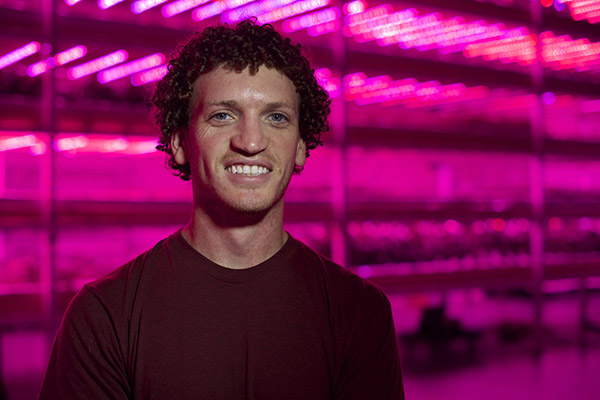
Orkin partnered with his similarly unemployed friend Cliff Jones to start their own company called Landscape Solutions. The company is focused on design-build for residential and commercial outdoor spaces.
“We focus on how sustainable landscapes can contribute to the development of a healthier community,” Orkin said. “We are using native plants, rain gardens, bioswales and things other than typical high-demanding ornamental landscapes.”
Focus on food
While Orkin’s main focus is on sustainable landscaping he also has a personal interest in extending his sustainability commitment to food production.
“I was living in a downtown fourth floor condominium trying to grow my own food,” Orkin said. “The only option at the time was to grow indoors on my windowsill using hydroponics. I started using a system developed by the Windowfarms Project, which got its start with a Kickstarter campaign.
In 2011 Orkin expanded from his windowsill plantings to a 4-foot wide by 12-foot long storage unit. He said that didn’t work real well because the unit lacked any kind of climate control.
The next move was to the roof of his 12-story condominium building.
“I discovered a 130-square-foot room on the roof of the building I was living in,” he said.” It was an unused utility room. I negotiated with the building management to rent me the room for a very reasonable rate. The room had a really tall ceiling which enabled me to grow using vertical farming with three different levels. That was in December 2012.”
In order to purchase the equipment he needed to set up his vertical farming facility, Orkin established the Urban Hydro Project.
“I did a Kickstarter campaign that helped to fund the build out and allowed me to test different crops and the other things necessary in a commercial hydroponic system. Urban Hydro Project was where the commercial business got its start. It was really the research and development arm of where I have transitioned to now.”
[adrotate banner=”23″]
Expanding again
Orkin has made a major production expansion by leasing a 6,000-square-foot warehouse that is about 5 miles outside of downtown Nashville. The new business venture is called Greener Roots Farm.
“I have divided the warehouse and curtained off a 3,000-square-foot grow room,” Orkin said. “I’m only about one-third of the way built out. Initially it was all I could afford. I am operating two vertical systems with space for two more. The warehouse production system is completely different than the one I was using in the condo building utility room.
“The warehouse has a completely new production design. It is a vertical set up with five levels of growing that maxes out at about 13 feet. I have a total of about 2,000 square feet of growing space that only occupies 224 square feet of floor space as it is currently built.”
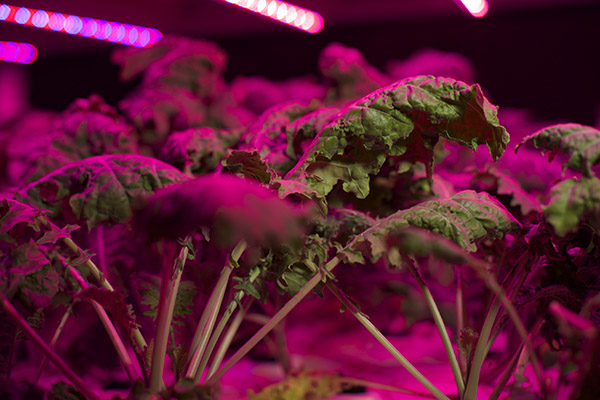
Orkin is also renting 1,200 square feet of the warehouse space to Nashville Grown, a food hub that aggregates food from local growers and distributes it to area restaurants, grocery stores and schools.
Orkin said one of the biggest issues when moving to the larger facility was thinking through how to scale the system.
“This included everything from water volume and structural concerns with water weight,” he said. “We had to think through whether or not the warehouse’s existing HVAC system had the capabilities to do what we needed it to do. There were facilities considerations as far as the height, cooling, and where the water is coming from and where it is draining to.”
Everything from seed sowing to harvest takes place in the warehouse. Orkin is using 4-foot long Philips LED Production Modules in the production system.
Maximizing crop production
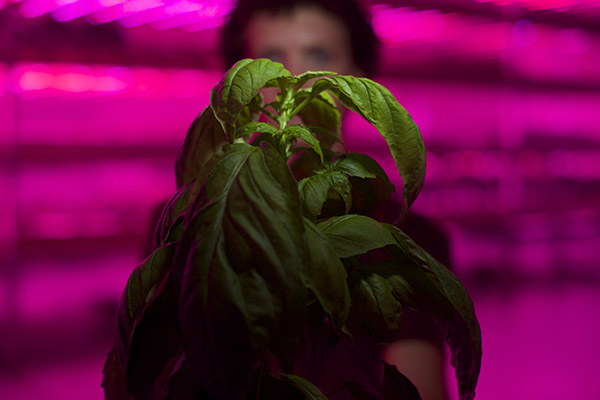
Orkin is producing a mix of herbs and leafy greens, including basil, cilantro, and parsley. He said he doesn’t have a major specific product.
“I signed a lease in April 2014 on the warehouse and we spent several months on build out,” he said. “The first seeds were planted on July 19. The crop mix allows me to provide some diversity and selection to the different restaurants that are purchasing from me. In the future there may be some direct to consumer sales at farmers markets. Right now I prefer being able to sell a larger volume in one delivery.”
Orkin said there are numerous farmers markets in the immediate Nashville area, including an “official” farmers market as well as several neighborhood markets.
“I don’t doubt that I eventually will carry many of my products to a farmers market on a regular basis,” he said. “Selling to restaurants I don’t harvest the plants unless they’re sold. It’s nice to be able to harvest for a restaurant customer and know that the crop was freshly harvested just an hour earlier.”
Orkin also said he shouldn’t have an issue with supplying local grocery stores year-round.
“I am really passionate about sustainability,” he said. “The one thing that kind of wears on me at retail is the amount of packaging that is required. Right now it’s nice to be able to put 4 pounds of product in one bag for a restaurant instead of placing that same 4 pounds in all of the 5-ounce clam shells that would have to be filled for grocery sales.
“I am trying to have the biggest impact on the local food scene that I can. I’m trying to produce and deliver the freshest local food that I can. Also, I have to figure out where I can be the most successful as a business.”
Excited about future opportunities
When Orkin started the Ultra Hydro Project he never expected the business to expand to the size it has.
“When my friend Cliff Jones and I started this business, we never planned to do it for as long as we have,” Orkin said. “It wasn’t necessarily our dream job. Although we have infused our passions into every aspect of the business, we can and do have a lot of fun with it. At the onset, however, it was something that we were able to do to make some money. It has just continued to grow.”
During the process of setting up the business Orkin went back to school for an MBA degree focusing on sustainability.
“A part of the degree program resulted in me going to California for a food security summit,” he said. “My mind was open to food security issues, the importance of local food and educating people about local food. Ultimately, I developed a passion for creative, innovative agriculture as it relates to augmenting the local food movement. I saw growing indoors as a way to remove seasonality when it comes to crops that in many instances are being shipped from thousands of miles away when there is this ability to grow it indoors.
“This concept of local food production presented a very interesting challenge. There is a lot of local food production going on, but not a lot of it necessarily makes money. For me the challenge is combining all of these factors. I want to be able to operate a farm with a business model that has the potential to make money and create jobs, while educating the community about how this can be done, and what it does for our food system. That gets me excited!”
For more: Greener Roots Farm, info@greenerroots.com; http://greenerroots.com.
David Kuack is a freelance technical writer in Fort Worth, Texas; dkuack@gmail.com.
1 Comment
thanks for info.